
Can Housing Affordability Be Fixed?
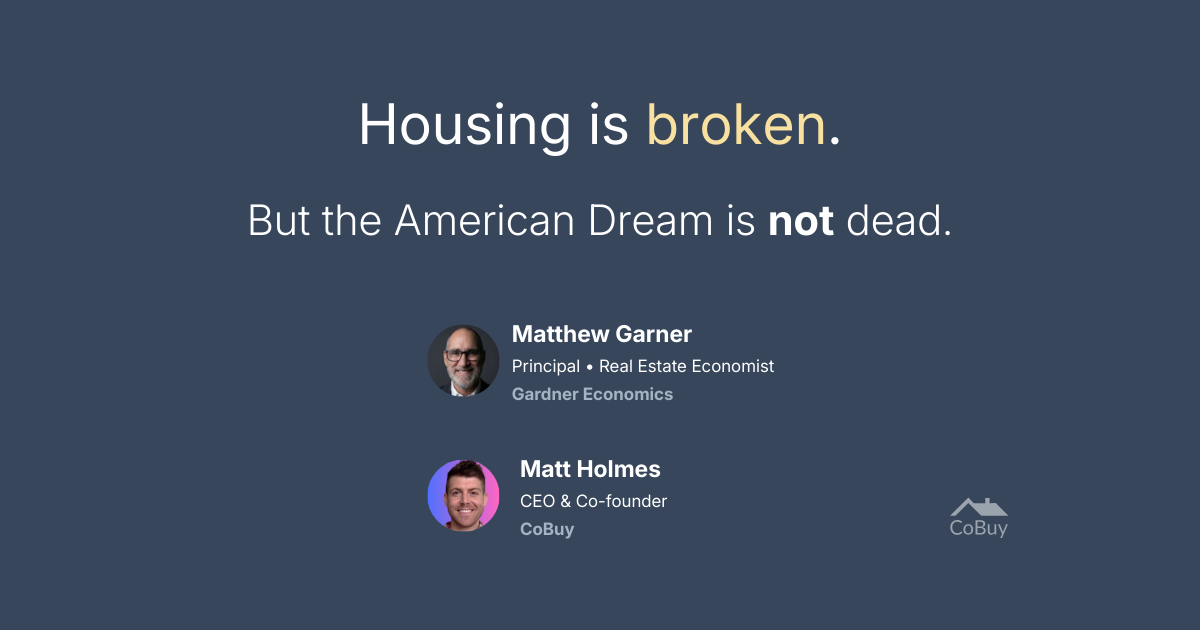
A plainspoken conversation with real estate economist Matthew Gardner on housing affordability, density, housing supply, and multi-generational co-buying.


⚡️ Key takeaways
• Housing affordability is primarily a supply problem, not a temporary market imbalance.
• Density and zoning decisions have long-term effects on prices and availability.
• Entry-level buyers are constrained because builders are not producing enough affordable starter homes.
• Multi-generational households and co-buying are rational responses to affordability pressure.
• Waiting for a market collapse or ultra-low rates is unlikely to be a viable strategy.
Overview
Housing affordability is broken for structural reasons. Supply, density, zoning, and how households form matter more than rates or short-term market cycles.
In this conversation, Matthew Gardner, Real Estate Economist at Gardner Economics, explains what is driving housing costs, why homeownership is harder to access, and why multi-generational households and co-buying are becoming practical responses many people are already using.
This is a straightforward discussion of how the housing market works today and what options people actually have.
Full Clip
Transcript
Below is the full transcript of the conversation for reference and accessibility.
Matt Holmes: Matthew, good to see you.
Matthew Gardner: You too, Matt. How are you?
Matt Holmes: Doing well. Thank you, man. I'm excited to talk about what's going on in the housing market today. So let's just focus on what's happening in housing in 2026 and what people should understand. Let's take it at a very high level first. We were talking about some of the themes you see in the market the other day. What do things look like?
Matthew Gardner: I think it's going to be interesting to see how 2026 plays out for a lot of different reasons. And I think you have a lot of consumers, certainly on the buying side, a lot of them over the last couple of years really been fence sitting for a couple of reasons. One, they're waiting—well, mortgage rates are going to drop back down to 3%, I'll wait till then. Or alternatively, they're saying, you know what, we had such a fast run up in values, we're on the verge of another market collapse, so I'm just going to wait—2009 all over again—and I'll pick up a home on the cheap.
And unfortunately, neither of those two things happened and neither will happen. So I think this year it really is going to be almost a reemergence, meaning the fact that people will have to understand that no, prices nationally at least are not going to collapse. Invariably rates are going to stay pretty much close to where they are right now going forward. And so the decision is: am I going to keep on waiting forever? The problem with that is if you do, maybe you won't be able to afford to buy that house you're thinking about. Or do I get off the fence? I think that applies on both the buyer and seller side of the equation. So bottom line, I think that 2026 is a year of a gradual slow return to some sense of normalcy.
Matt Holmes: Okay. And so on that note, the other day we were talking about affordability versus desire and some of the shifts in demographics, generational stuff. You brought up a great point. There's a lot of pundits out there in the press saying that people, especially younger generations, they no longer really want to own. They want ultimate flexibility. You challenged that. Can you tell me a little bit about your views there?
Matthew Gardner: Sure. You know, it's funny that you mentioned this. Again, I'm probably dating myself. I remember doing a radio show back in 2009, I think it was, or 2008. And I got into it with one of the other panelists who was a real estate professor from Wharton over at Penn, who was saying exactly that. Well, you know, this younger generation, they're never going to want to buy a home. They want flexibility. They're going to have twice as many jobs in their careers as us older folk. And I caught her on it. Said, absolute rubbish. I don't agree with that. Ultimately I believe that I was right.
And here's why. I think for the better part, and certainly if you look at it from the perspective of everyone, every homeowner, home ownership is the way that households create wealth. More than anything else. And the numbers have been floating around for years about that. You know, if you think about the median household wealth of a homeowner household in America, depending on who you talk to, it's somewhere in the low $400,000 range. And these same people are saying, okay, the median household wealth for a renter household is what? Somewhere around $15,000. So yes, it is very much the way we create wealth. And that is because of one thing: 30-year fixed mortgage rates, which we are the only nation out of 185 nations around this globe that have a 30-year fixed rate product. So I think those that say, well, they don't want to because they want to be nimble—I would push back on that and say, no, I think that they do want it. If for no other reason, they can paint their own walls if it's the house that they own.
Matt Holmes: Okay. And so given the affordability constraints, particularly in larger coastal metros, but MSAs all around the country, and even going further out in some instances to suburbs and rural areas, affordability remains a massive challenge. To your point, particularly if you are younger, millennial—I mean, for anyone really, but particularly for Gen Z as well. So how do they reconcile the fact that we don't expect house prices to bottom out? What are they going to do if they still want to own? What does that look like?
Matthew Gardner: Well, that—I mean, that's the discrepancy we have. You see kind of us more mature people, we've done great on housing and we really have over the years. The trouble is now you have a generation—the reason why we've done well, let me explain that a bit further—is that let's start out with the 1980s through to 2020, let's say 2022. What have mortgage rates done over that 40-year period? They've dropped down from almost 20% in 1982 down to the silly low of sub 3%.
So at that time, rates were coming down, incomes were going up. So we were in a very good position, and mainly because if we owned our homes over time, the mortgage payment didn't change, but our income did. So we've done well. The problem that I see today, and I've been screaming it from the rooftops for years now, is the fact that great for us, but if you think about the entry-level buyer, well, they've really been priced out of the market. And I've said this for quite some time. I think the American dream is alive, but it's on life support. From the perspective of the entry level, the ability for households and younger households to get their foot on the first rung of the housing ladder—that's the biggest problem we've got. And quite frankly, builders, they're not building to that tsunami wave of demand we're going to see over the next 15 years.
Matt Holmes: Yeah. And you mentioned, you know, this is specific by jurisdiction, right? But if we look at greater Seattle, and again, a lot of coastal cities, we have geographic constraints. So there's all kinds of considerations when we think about rising input costs, when we think about how those cities can grow. Just the topography often kind of shapes what happens.
Matthew Gardner: Yeah, and I'll happily opine about that. But I think the old days that we used to think that the middle part of America was dirt cheap—no. I mean, Columbus, Ohio is not affordable technically anymore. So that is a bit of a misnomer, because the argument always was, well, you know what, they've got land all over the place. Look, think about Texas. Shouldn't be a problem. Maybe we'll get to that in a bit. But as far as to your point, yes. And a couple of reasons why. Certainly, as you said, topography. Here in Seattle, which is where I'm based, too much water, too many mountains, still I'm afraid a fairly lousy mass transit infrastructure, whatever anyone says.
And so that is unto itself a constraint. But as much as that, you have to look at the almost the political makeup. You tend to find that Democratic states have more stringent land use codes than Republican states, and that comes into play as well. And it certainly does here in Washington state where we created what's called an Urban Growth Boundary as we passed the Growth Management Act in 1990. And in essence, it said: inside these artificial lines, you could build housing. Outside of those lines, one house per 5 acres or one house per 20 acres. End of story. Those lines haven't moved in 35 years. So when you have net new—well, no new supply but net new demand—what happens to the prices of anything? They go up.
Matt Holmes: Yeah. Well, we are starting to see, I mean, over the last few years, certain jurisdictions relax that, right? I don't know if that started with Minneapolis 2040, but we are seeing single family zoning be relaxed.
Matthew Gardner: Yeah. And you did. And quite frankly, everyone has been stealing from Minneapolis. That was a plan they put in place which basically said you can build multi-family inside any single family areas. Well, then Governor Brown in Oregon stole it and they basically implemented the same thing. Governor Newsom then stole it and they did. And then Governor Inslee here in Washington State, House Bill 1110, which I was fortunate to help craft and was involved in.
So yes, now that is good theoretically. Have we seen a plethora of duplexes built in Minneapolis? No, we haven't at all. So it was never going to be a panacea by any stretch of the imagination. And certainly if you think about here in Seattle, yes, it's in place. You can build up to six units now on a single family lot. But we are suffering from the comprehensive plan of 1924. I know, I kid you not, bear with me on this one. It basically was, before that, you could—if you wanted to build a stable next to a house, you crack on, whatever you're happy with, no problem.
But what happened is that at that point they decided, okay, this is where businesses were going to be. And they kind of divided the city up. But most of the residential components were single family, not multifamily. Why? They wanted to push poor people out. And so over the last hundred years, what have we done? We built it out. So in order to build a six-pack or even some duplexes, you've got to buy homes that are already there. Median price in the city of Seattle is north of $900,000. But you're buying it for the dirt—and dirt value—but you're buying the house, which you have to rip down, by the way. So mathematically, and just from a builder standpoint, it makes no sense at all.
Matt Holmes: Right. It still has to pencil.
Matthew Gardner: Exactly. I mean, the bottom line, Matt, is that builders were put on this planet to do one thing: build. And if they are not, it doesn't matter that you can have all these people like me with doctorates and what have you going to say this is the reason why they're not. No, they're not because it doesn't make financial sense for them. When you break up building a home into the four cost quadrants—land, labor, materials, and regulatory burden—so they look at the numbers. That's what's hurting them because they'd love to build but they can't. And certainly not at the entry-level price point, because that's really where the demand is, quite frankly, right now. Because us older folk that have mortgages which are at sub 3%, we're not moving.
Matt Holmes: Right, right. Why would you? Exactly. And so one of the other things that we covered the other day, and I like how you boil things down, because if we take a step back, we have a supply side problem, don't we?
Matthew Gardner: That's all. That's all housing affordability is. Absolutely.
Matt Holmes: And so to that end, I think that's one of the big drivers behind multi-generational household formation that plays in, obviously, with demographics. In many instances, you have aging, potentially boomer parents, or even grandparents, and then younger folks teaming up to buy and own a home together. Oftentimes rent as well. But so you get some social benefits there. You get economies of scale. I want to talk a little bit about what you're seeing because you have been talking about multi-generational households lately. And then I also want to ask you, are there opportunities in terms of—a few years ago there was a supply demand mismatch, or at least a lot of pundits were talking about that. Does that persist? And how does that factor in? How does—what's the interplay, if any, between multi-gen households and any supply demand mismatch if it still exists?
Matthew Gardner: Well, in terms of multi-generational housing, and if you think about housing from multi-generational within the same household—so not friends, but family—yeah, and certainly up here it's a lot of it is a function of not just demographics. Yes, we know we're getting older, baby booms aging out. But you also—we rely up here significantly upon immigrant migrants. In fact, in King County where Seattle is, we've had domestic out migration through COVID, again, mainly because it's too expensive. But that has been replaced by households coming in from outside of the United States, a lot from Asia, and who have a great propensity for multi-generational housing. A lot from India as well. But you also get the Europeans, who quite frankly have always thought renting is a complete waste of money.
And so you have that plethora of people moving in and that, I think, over time absolutely is going to be a larger component. And quite frankly, on top of that, you also have got Hispanic households. And I think that the home ownership rate of Hispanic households is going to grow at the fastest rate of any ethnicity, in my opinion, in the next 10 years.
Affordability starts with alignment.
See if co-buying makes sense for your group's finances.
Get your CoBuy Decision Brief™ →
$250 per group
Matt Holmes: Okay. So that makes perfect sense. Do we still have a supply demand mismatch in terms of—you talked about lack of starter homes. Are we still seeing larger homes, not sitting vacant per se, but with maybe aging homeowners and no kids in place? Is that something that still exists?
Matthew Gardner: Yeah. So we continue to create households in this country and we do. Now certainly this last year it's been at a slower pace because of the current administration. But you still got—said the second half of millennials are getting older. Then you've got the wave of Gen Z after that. My son's got his last year at Gonzaga. So I don't want him moving in with me. So that I think that is still the goal.
We have a situation where we're not building enough but we're still creating households. And to a degree, in a lot of those expensive markets—here, Oregon, and even say quite frankly Eastern Washington, Spokane, Boise, Idaho—we're not building enough at that entry-level price point. At the same time, these larger homes, they're not trading, not just because of the fact that people have got a remarkably low mortgage rate. I mean, the old adage, right, when you retire, you sell up and buy a condo in Yuma, Arizona or something. No, they're not. And what's fascinating is that a survey done a while ago said that over 80%, I think it's 85%, of retiree households wanted to age in place. They didn't want to move.
Two reasons why. One of which is they've got too much stuff, and the kids don't want it. But more importantly, is the fact they think if they downsize, then the kids aren't going to come and visit them. And so they're staying really where they are. Now, where they're forced to move because of the amazing amount of equity they've got built up—we're sat on, I don't know, close to $40 trillion of equity in our homes in the U.S. So there is that tapping on that. So we've certainly seen some of that in some interesting mortgage products. But more than anything else, if they're not downsizing, the move-up buyers, they're limited with options because there's not enough supply for them. So they're not moving. And if they're not, then the first-time buyers are shot unless their needs are addressed by building more.
Matt Holmes: Yeah. There are a lot of factors at play, right? If you think about kind of the social considerations that you just outlined, and then also just natural human inertia. I mean, it's a big deal. If you've lived somewhere your entire life, you have a home, you want to realize some of that equity, but it's not just press the button, it's done. I mean, that's a big endeavor. And then you think about your rate, and, you know, where are you going to go?
Matthew Gardner: Yeah. Well, yeah. I mean, housing—I've always said the same thing. Ownership housing is not fungible, right? Fungible meaning easily tradable. And so unlike a stock, I can press a button and sell it. You can't do that. And it really is—they say what?—moving house is the second or third most stressful thing next to divorce and death. So yeah, it's a big issue.
So yeah, there's also reasons why people aren't. But going back to the multi-generational side as well, because of the aging out that we're seeing now, we're looking at assisted living facilities or independent living facilities if you're moving into that. Which is certainly a booming industry, but my lord is it expensive. So again, that kind of can lead a lot of households to think about, well, how can we combine resources financially and move into that multi-generational housing unit as opposed to spending kind of pretty much the child's inheritance on rent in an independent living facility.
Matt Holmes: Yeah, it's incredibly expensive. And that brings in—so many factors enter into the equation when we start to think of it in those terms. We see a lot of folks who didn't necessarily intend for things to end up a certain way, but they do for economic reasons, financial reasons. And so that's a great lead into my next question, which is about the industry professionals involved. So you have talked about how our real estate market and real estate systems here in the U.S. differ quite a bit from others in the Western world. We clearly have, what is it, like almost 3 million real estate agents nationwide?
Matthew Gardner: Oh, I think it's a lot less than that now, but I haven't got the exact numbers. I know it's been in decline, which invariably it ebbs and flows with how buoyant any market is.
Matt Holmes: Right, right. We do know that commissions are higher on the whole than almost any developed nation.
Matthew Gardner: Than any nation, I believe, other than Monaco. So yes.
Matt Holmes: Right. So there's a spectrum of talent, and I guess, when we're thinking about real estate agents and loan officers, talk to me a little bit about that side of the equation and the data. Because when you and I had a chat last week, you were talking about how more and more consumers are going to be looking for real estate professionals who are data-driven.
Matthew Gardner: Yeah. So it's interesting when you think about it. I mean, really going back multiple decades, back to the '50s, selling homes tended to be the domain of the housewife. And that was how it worked. A lot of seller financing happened, these kinds of things. And it took a long time, quite frankly, for it to become actually a per se an industry that really started probably in the 1970s, I'd say. I know it was around before then, but really started to explode then. So about 50 years ago, give or take.
And the difference between the U.S. and other countries, it's significant. Most countries, a real estate broker is a salaried employee of a company. They're not independent contractors as you see here on the buying and selling side. Commissions here are remarkably expensive, and that is a big problem. That's actually an impact on affordability, if you think about it. In general, ballpark, the minute you close on a home, you're close to 10% underwater because that would be your cost to transact, including brokers fees, real estate excise tax, and so on.
So that is very different. I mean, certainly there are—it's not 2% or 1% everywhere, although a lot of countries, that's what it is. So it is a very small component. But again, these are salaried employees of a company. But even where it's not—in Germany and Austria, good examples—it's a sliding scale. So x percent up to a certain point, and it slides down the more expensive the house is. So it really, when you think about house prices and values, home sellers want to cover that nut. So they're naturally going to push pricing as much as they can in order to make sure that their net net is what they hope it to be. So that comes into play on issues with affordability and what's pushing prices further.
As we talk about mortgages, America's remarkable. It's the only country that has a 30-year mortgage because in essence, a 30-year mortgage makes no sense. If you take the housing out of the equation, why would I lend you money for a 30-year period at, quite frankly, a remarkably low rate with no prepayment penalty? It doesn't make sense. And so that's why Fannie/Freddie came along. That's why the 30-year came along in what, April of 1971? Because it works. Because they borrow money from the government at ultra-low rates.
So what—why homeowners, there's that big disparity between how much a homeowner is worth versus a renter—is that when you buy a home, you have your mortgage payment. Guess what? That payment doesn't change until you refinance or sell. Yet, what happens to your income?
Matt Holmes: Hopefully it goes up.
Matthew Gardner: It goes up. So your share of your income you dedicate to a mortgage payment does what? Goes down. A renter on the other hand, on every 18 months or year or whatever their lease expires, what happens to their rent, invariably?
Matt Holmes: It goes up.
Matthew Gardner: There you go. So you've got no way you can create wealth. And certainly if you look about beyond that, there's the kind of fixer-uppers and people putting, investing sweat labor into their houses. So but excluding all of that, it is—that's why 65% of American households own their homes, 35% rent. That's been the average since 1965.
Matt Holmes: Yeah. Well, you raised a ton of good points. A few things. One, I don't think that people understand how high transaction costs are as a percentage of the purchase price. Two, what we've seen over the last decade dealing with CoBuy is that a lot of folks don't appreciate that this is all capitalized into the price of the home. So you do pay for your real estate agent. You know, obviously you're paying for your mortgage. A lot of folks don't understand how that breaks down either. But because of the next thing that you pointed out, which is we effectively have, in essence, government-subsidized debt for buying a home. So it's an artificial incentive to buy a home. And all of these factors are pushing up prices of home over term. Wouldn't you agree with that, more or less?
Matthew Gardner: Oh yeah. I think absolutely right. And so it's really, if you think about it in those terms, we are—this country's very unique in that respect.
Matt Holmes: It favors the homeowner.
Matthew Gardner: Oh, if you're—yeah, exactly. So, but in terms, to your point about brokers and what they bring to the table, I mean, certainly they are remarkably good. I know a lot of real estate brokers, they're fantastic. But because things have changed somewhat with buyer representation now, and who pays for what, I think really we're getting to an era whereby brokers that represent home buyers as opposed to sellers—if the seller's not going to pay their fee, their commission, the buyer is—what they need to really understand is what they're bringing to the table and the value they bring.
And I've got to go back to really decades ago. Historically, commercial real estate brokers have had teams of analysts and economists going back forever. And certainly all the major brokerage houses did. But when I—probably gather I'm not from around here—but when I came to the States, I looked around and said, who does it? And back then, before Zillow existed, no one did. It was really quite remarkable. And it really has, since technology, internet, and Zillow certainly, that we've actually seen far more attention paid to the numbers, to the analysis, to an understanding of broader factors that impact housing. We've seen it obviously inside academia, but not necessarily outside.
And it does make sense because the value of residential real estate in America is valued multiplies more than all commercial assets. And so one would like to think that especially for 98% of us buying a home—most expensive thing we'll ever buy in our lives—that really having a better understanding of what it really is and what are the risks. And certainly from a younger potential buyer perspective, because for a lot of them, they saw their parents possibly go through foreclosure through 2008. Are they very cautious? Absolutely they are. So they've got a lot of questions that they're going to be looking to something more than ChatGPT to answer.
Matt Holmes: So if we distill that, real estate agents are going to need a competitive edge, and that's what the market's really demanding, right? Real estate agents who have access and command of data, who really have a beat on the market. And probably increasingly specialization too, I would imagine.
Matthew Gardner: Yeah, I mean, we certainly see more of that. And certainly if you think about it, I was actually giving a speech last summer in New York, in Manhattan, obviously the domain of the condos, and then the whole bizarre co-op part. So yeah, it's very specific to—so I think really, yeah, you're seeing that breakdown because you do. Brokers representing condos are the world—I know a lot of them. Others, single family. Others, land. Others, builders. So yeah, you are seeing more of that, less generalization, and more specialization.
Matt Holmes: Okay. So before we wrap up here, there's a lot going on in the market, a lot to digest from a policy perspective. What do you think can be done, should be done, will be done—which are obviously different things?
Matthew Gardner: Yeah. So bigger picture, first I'd say what I'm happy about is that I'm hearing politicians both at the city, county, state, federal level, talk more about housing in the last couple of years, and quite frankly, I've heard in the last 20. That's the positive. However, there's a difference between talking about it and actually getting something done which is effective.
So certainly, just like that, 1110—with different plans have been put in place—and people are starting to look more about how can we make it easier and cheaper for builders: streamlining permitting in land-constrained markets, smaller lots. So it's lots of these things that are being discussed and that's good. But quite frankly, some of the ideas certainly recently that are coming down from the administration are quite frankly a complete waste of time.
I mean, 50-year mortgages. I mean, I just—for me, you mention that word, I can start laughing immediately because it just—the numbers appear in my head. What the interest rate in my opinion would be today, north of 7%, if they were to bring it in. But who would want it? Who would buy those bonds? Two, we'll see foreclosures increase, because there'll be next to no equity buildup. There's lots of reasons why it doesn't work.
Portable mortgages? No. Again, mortgage brokers would be up in arms. Because they'd be losing what, almost $2 billion a year in income from them. But if you're going to borrow to buy a bigger house, then that's another separate loan on top of—if it's a different, if it's a condo versus single family, you're going from one to the other. Underwriting criteria is completely different. Again, makes no sense.
And finally, that's still going on right now, the view that institutional investors are just the nastiest people out there buying every home. And that's what's keeping first-time buyers from buying. Institutional investors, who I define as owning more than 1,000 units, they're a rounding error. They might own—numbers I've seen, around 600,000 units out of 83 million. So—
Matt Holmes: And that was news to me, because we see a lot of this in the press, right?
Matthew Gardner: Yeah. And you do. And again, because people kind of think something and make certain assumptions. And of course, coming out of 2008, yeah sure. Blackstone buying up because they were buying remarkably cheaply. And they've been, actually most of them have been net sellers recently rather than buyers. Point one. But point two is that for a lot of them, the math doesn't make sense for them. Now, they can borrow money potentially cheaply, but if they're going to be renting that unit out, which you would have to do to find a return—if that return's not enough, that doesn't justify buying, then they won't buy it. So they've been net sellers.
So I think what they're trying to do is find somebody to blame. Yet, quite frankly, now we are hearing noises about this, which could be interesting to chat about briefly, which is—I've always said the same thing. If you want to see a significant growth in the number of homes coming to market, therefore increasing supply outside of the new construction arena, look at mom and pop investors. They own almost 80% of all investment properties out there. They've made money on it, they've done great. They would love to sell, but they're not because of capital gains taxes. So now there's some legislation being talked about that will negate that, apparently.
So if that happens, then that could potentially bring in a lot of units to the market. Will it work? Will it happen? I mean, again, with government it's very hard getting anything across the finish line, as across the start line. We'll see. But I think rather than all these things, we just need to make it easier for builders to do what they do best. Build housing. Build housing that one, entry-level buyers can afford, and two, a home that the entry-level buyer would want to buy. If a builder can figure that one out, they'll make more money than Croesus. They really will.
Matt Holmes: And we relieve the pressure on the supply side, right? So that's a huge unlock. Well, Matthew, this has been great. Thank you so much for your time. If people take one thing away from all of this, what do you think it should be?
Matthew Gardner: Think about your first house. Don't give up. It's very easy to look and say, you know, I can never—just don't, hang in there. But I would say, don't over-leverage. I mean, don't worry every week that you can afford to pay, make that mortgage payment. But at the same time, don't think that the market is going to collapse and at that point you'll be able to pick up a couple of houses cheaply. Just don't see that happening.
So persevere. I know it's hard. But quite frankly, is it worth it? I think so, but I feel for them. And I wouldn't like to be in that situation myself, but thankfully for me, that was a number of years ago now. But hang in there. Hopefully things will turn around, and quite frankly, you'll be able to do something and get into owning somewhere. Because it is a remarkable feeling when you do.
Matt Holmes: Awesome. Well, thank you very much, Matthew. Appreciate your time.
Matthew Gardner: You're welcome. Great talking to you, Matt. Take care.
Pooling resources is step one. Structure is step two.
Agreements, finances, exit plans—built for groups of 2–4.
Get your Co-ownerOS™ Annual Pass →
$1,000/year per group · Agreement, expenses, equity, exit planning
Attribution
Matthew Gardner is a housing economist and principal at Gardner Economics, and formerly served as Chief Economist at Windermere Real Estate.
LinkedIn: https://www.linkedin.com/in/mjdgardner/
YouTube: https://www.youtube.com/@MGardnerEcon
Matt Holmes is Co-founder and CEO of CoBuy.