
Course Menu
Co-ownership Agreement
⏱ 5 min
Overview
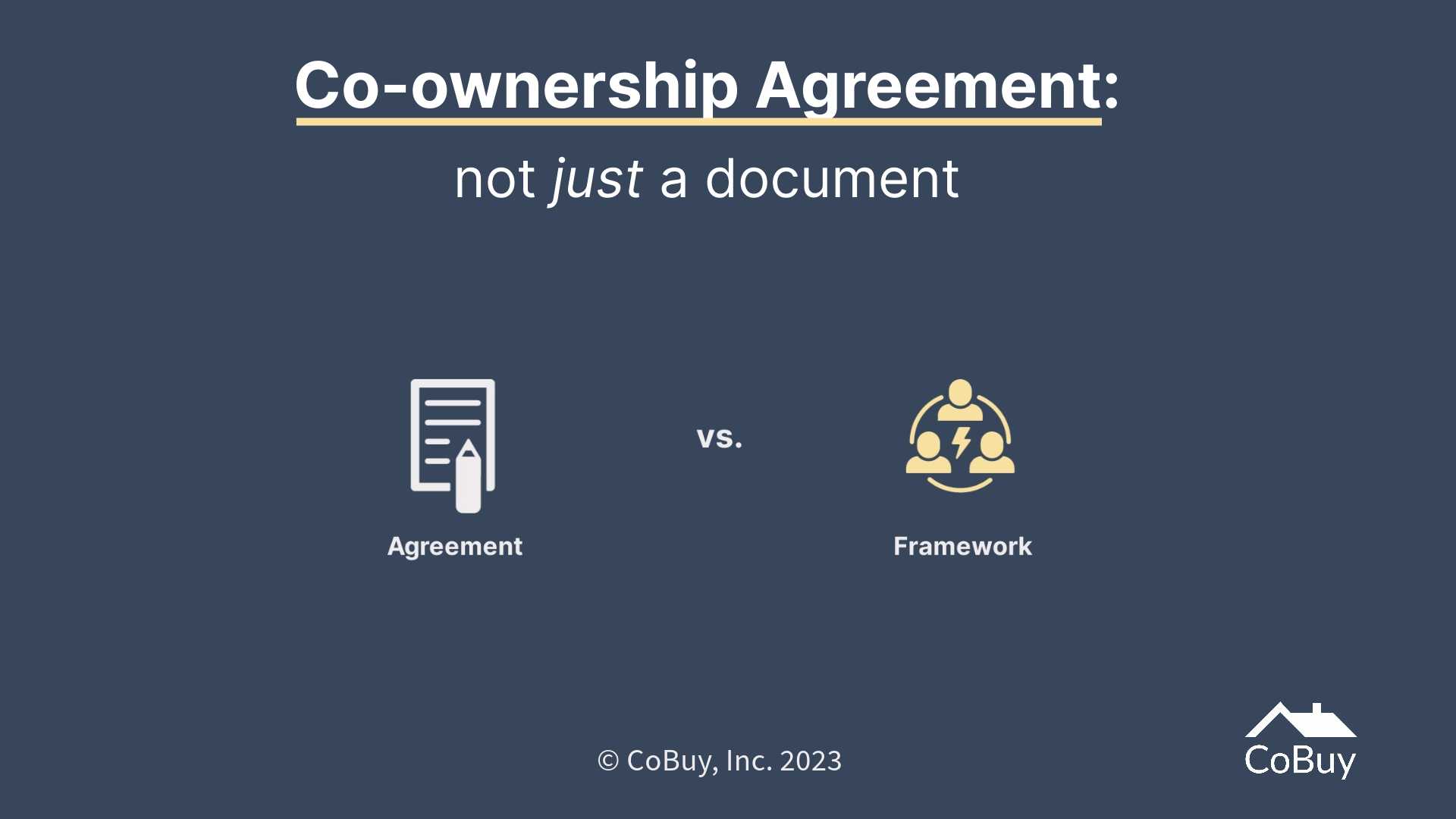
The Co-ownership Agreement lays the foundation for co-ownership. It is a legal document that outlines the details of joint ownership and management of the property between you and your co-owners. In it, you define the terms, structure, and policies of your co-ownership arrangement. In short, it's more than just a document—it's the backbone of your co-ownership, adaptable to your needs and expectations.
📝 What's a Co-ownership Agreement?
— CoBuy (@gocobuy) July 30, 2023
A legal document that outlines the details of joint ownership and management of a particular property between two or more individuals.
But it's not just a document—it's the backbone of a co-ownership arrangement.https://t.co/wkCmY5N2oG
Role of a Co-ownership Agreement
A robust Co-ownership Agreement supports healthy relations, smooth sailing, and return on investment.
1. Streamlines operations
An agreement details roles, rights, and responsibilities, making management smoother. It acts as a source of truth that prevents misunderstandings and creates non-repudiation.
2. Prevents conflict
The agreement establishes clear expectations, including expense distribution, property use, and decision-making methods. This roadmap helps to pre-empt potential disputes and provides a mechanism for resolution, protecting relationships, and stability.
3. Protects against risk
Co-owners don't have the same legal or tax protections as married couples. An agreement provides a legal framework to safeguard co-owners' rights and interests.
4. Limits financial exposure
Co-owners often jointly finance their property, making them equally liable for debt repayment. A comprehensive agreement can protect co-owners from financial mishaps.
5. Simplifies the exit
Every co-ownership will eventually dissolve. Developing an exit strategy and documenting it in the agreement can make this process less stressful and expensive.
What a Co-ownership Agreement Covers
The details, format, and level of granularity depend on your situation. Generally speaking, it's wise to include the following:
- Participants
- Occupancy
- Property description (consisting of address and a proper Legal Description)
- How you hold Title to the property
- Details of the home purchase
- Mortgage Information
- Ownership structure and individual ownership percentages
- Individual contributions (financial capital contributions and non-financial contributions)
- Roles, rights, and responsibilities
- Expense allocations (recurring, non-recurring expenses, emergencies)
- Mechanics of payment
- Maintenance and repair management
- Decision-making
- Dispute resolution
- Contingency planning
- Documentation management plan
- Exit strategy
A well-crafted Co-ownership Agreement includes additional elements that are both official and functional.
➡️ Definitions and provisions: Define key terms and conditions within your agreement to prevent misunderstandings and establish clarity.
➡️ Governing law: Specify which state's law will govern the agreement, which generally corresponds to the state where the property lives.
➡️ Written notice: Outline how formal notices, like changes to the agreement or critical decisions, should be communicated. You should identify the method (e.g., email, certified mail) and the timeframe for a response (e.g., 30 days).
➡️ Review and update schedule: Treat your co-ownership agreement as a living document. Schedule regular reviews to keep it up-to-date and representative of your current situation at any given time.
➡️ Co-owner contact information: Include current contact information to ensure clear lines of communication.
How to Make It Official
Follow these steps to execute your agreement:
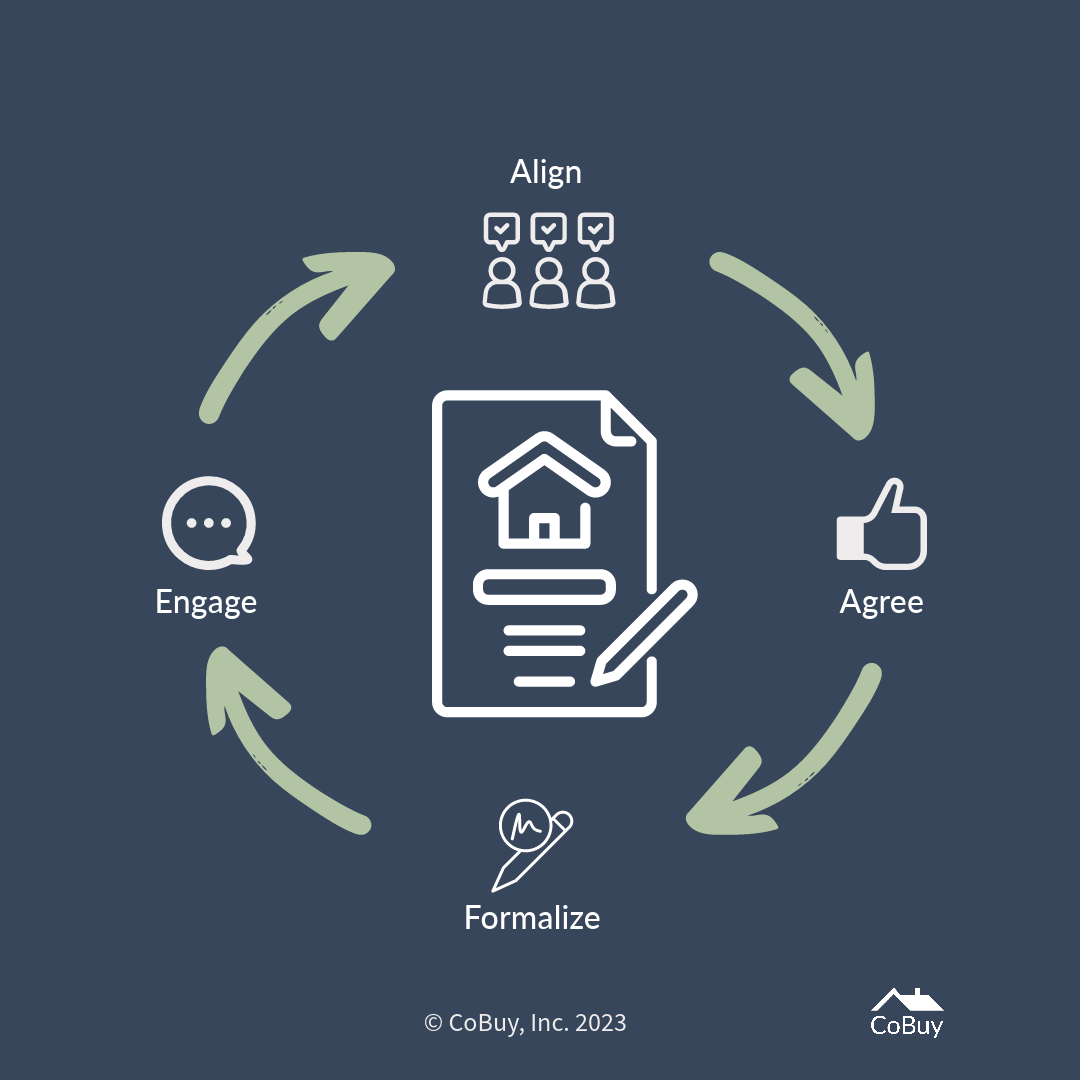
Review and agree: Ensure all co-owners thoroughly review the agreement, understand all provisions, and agree to them. Address and clarify any areas of doubt.
Sign and date: Each co-owner should sign and date the agreement initially and every time it is updated. Witness, notarize, or digitally sign: This adds an extra layer of legitimacy and protects all co-owners.
Create a Memorandum of Agreement: This is a shorter, more concise document that outlines the basic terms of the co-ownership. It doesn't include all the agreement details but can be used to establish a record that an agreement exists without publically divulging sensitive information.
Record your Memorandum of Agreement: Submit or deliver your Memorandum of Agreement to your local County's recording office to officially record it on the public register. Recording your Memorandum of Agreement ensures the Co-ownership Agreement is recognized as a matter of public record and establishes constructive notice. Be sure to keep a copy of the executed Memorandum for your records.
Formalizing your Co-ownership Agreement is essential to protecting your rights and interests as a co-owner. By following these steps, you ensure that your agreement is legally binding and enforceable.
"What if we want to [change] our co-ownership agreement? What if we want to terminate or separate ahead of the five-year commitment we had talked about between us? CoBuy helped us understand the options and that we could edit our agreement down the road."https://t.co/kPkEc4q17E
— CoBuy (@gocobuy) July 22, 2023
Need help with your Co-ownership Agreement? Meet Co-ownerOS™.
With Co-ownerOS™, it's easy to create a Co-ownership Agreement.
🤝 Streamline decisions
⚖️ Define ownership interests
📝 Co-create custom agreements—fast (or not)
✍️ Digitally sign from anywhere
🔐 Secure docs and records
🚪 Plan your exit strategy
⚡️ Update anytime with a few taps
One app to put you and your co-owners in control.
Eliminate guesswork, avoid conflict, save $1,000s on legal fees, and cut 120 hours of admin a year.