Course Menu
A Framework for Success
⏱ 5 min
In the wild, co-buying is complex, risky, and inefficient.
We can define a conceptual framework to address these challenges by answering fundamental questions about co-buying and co-ownership.
What is the objective?
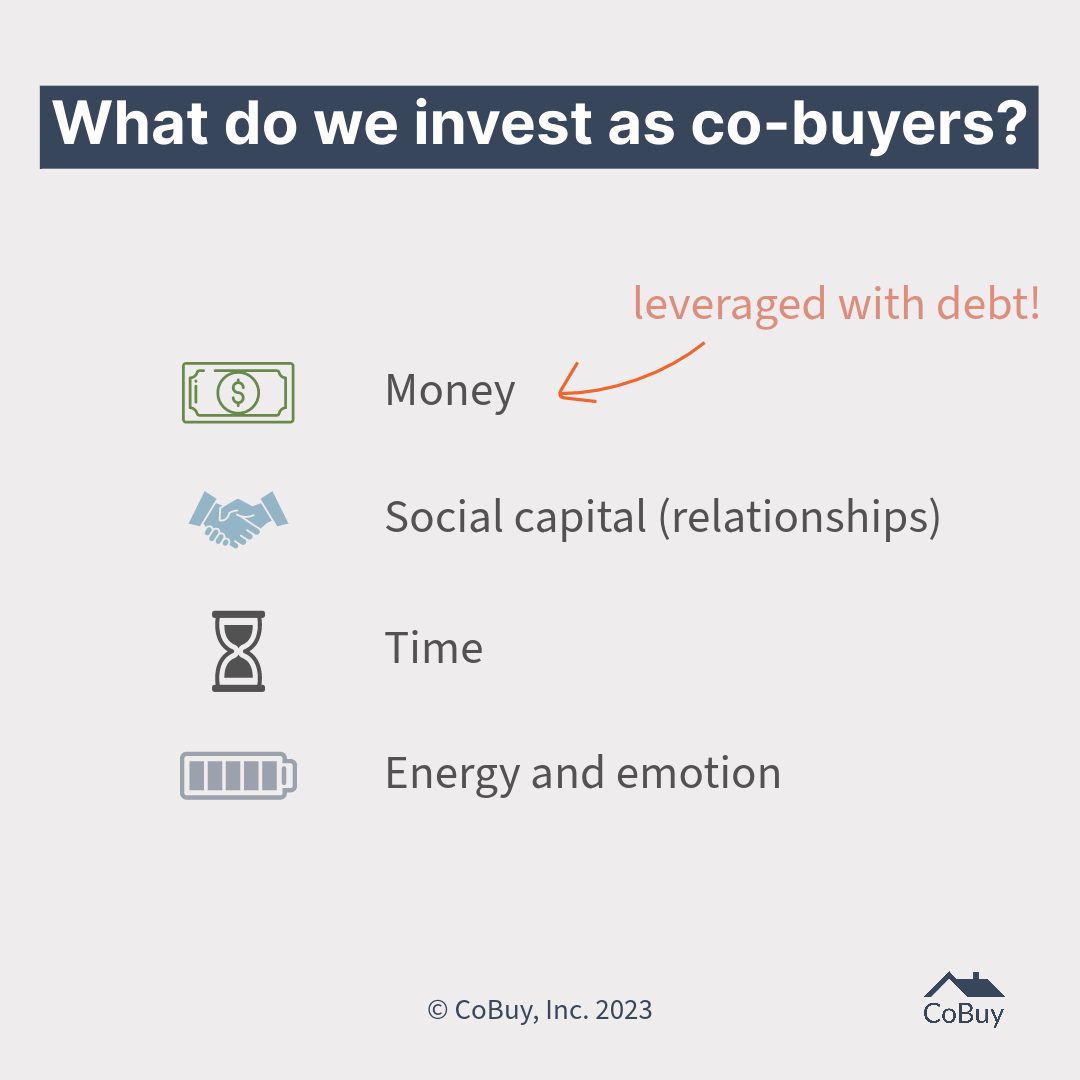
Homeownership, of course. But “success” in co-ownership is achieved by maximizing the Return on Investment of:
- Financial capital (cash)
- Social capital (relationships)
- Time
- Energy
That means:
✅ Building wealth
✅ Building on our relationship(s)
✅ Feeling that we’ve spent our time wisely, not wasted it
✅ Feeling good emotionally
What is the time horizon?
The entire co-ownership lifecycle.
What other parameters are relevant?
As in a business partnership, the odds of “success” increase with planning, structure, and management.
In co-ownership, this applies to five inextricably linked dimensions of the joint venture:
1. Social: interpersonal relations and interactions between co-owners
2. Financial: expenses, payments, taxes, accounting
3. Legal: ownership structure, documentation, compliance
4. Operational: coordinated day-to-day management of the home
5. Risk: identification, mitigation mechanisms, remedies
All of the above are related; they do not exist independently.